
Skip to content
Strategic Design

See your contact center as it really is.

Transformation starts with an unbiased view of your operations. From the inside, getting the full picture is more difficult than most leaders expect. Bucher + Suter can help.

Clarity before commitment.

When it’s time to make business-critical decisions, the cost of incomplete information is high. With a Bucher + Suter contact center evaluation, you get a structured, evidence-based look at how your contact center actually runs—before you commit to changing it.

Instead of a generic audit or pre-determined checklist, we work to understand your specific environment. How performance is shaped and evaluated. Where friction comes from. Where the operational and commercial case for change is strongest.

What we look across.

Contact center performance ultimately comes down to how different parts of the system interact with each other.

Our evaluations span five areas:

#01

Technology and platform configuration.

Are your platforms configured to support the way your teams actually work? Over time, even well-designed systems can drift from operational reality. We look at where that's happening and what it's costing you.


#02

Data and integration health.

Where is information getting lost, duplicated, or delayed between systems? We look at what that actually costs the operation day to day.

#03

Processes and workflows.

Which processes create friction? Which workarounds have developed over-reliance? We distinguish between issues that are structural and those that are addressable in the near term.

#04

Agent experience.

Where are agents losing time, context, or confidence? Agents typically feel the effects of system inefficiency first. We look at where their experience is being degraded by unnecessary friction.

#05

Performance visibility.

Are the right things being measured? We look at whether leaders have the visibility they need to make confident decisions, or whether the picture has gaps that matter.

How we work.

Every evaluation is different, but the way we work stays consistent. We ask the right questions, work alongside the right people, and stay focused on what the findings need to produce.

#01

Inside live environments.

We work around operational realities rather than waiting for a quiet period that rarely arrives.

#02

With the right people in the room.

We cooperate with IT, operations, and the senior stakeholders who carry accountability for contact center performance.

#03

Toward a practical outcome.

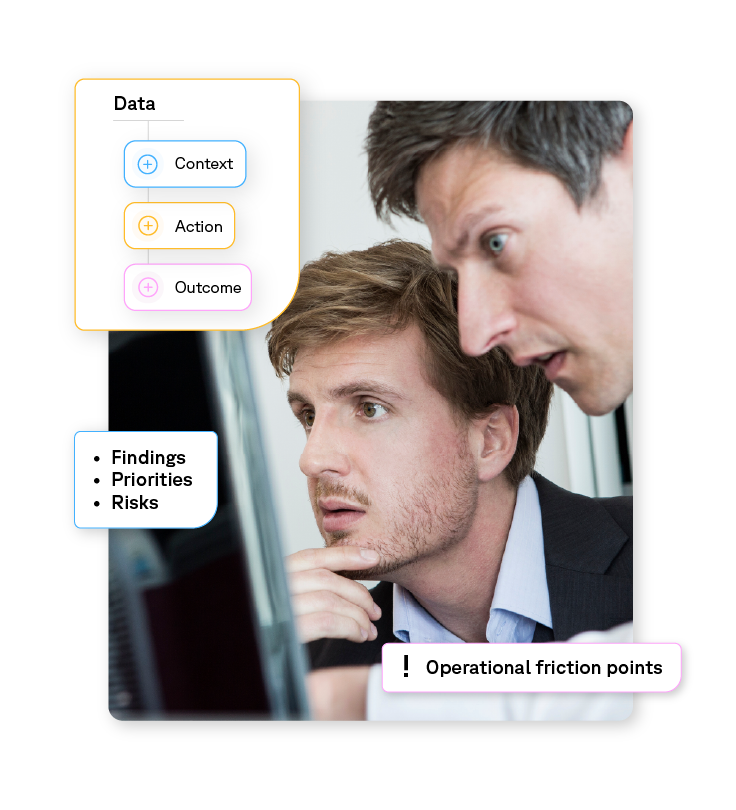
A clear, prioritized view of where improvement is possible and what it would take to get there. An informed view of the risks you'd be carrying into any future transformation if they aren't addressed first

Make clearer, faster decisions grounded in what's actually happening. Organizations that start here tend to move with more confidence.

Clients who started here.

Testimonials wave

Helvetia

Large-scale contact center environment where structured evaluation informed omni-channel improvements and broader operational change.

See the Helvetia case study →
Testimonials wave

Swiss Post

Complex, high-volume service environment where understanding current performance and system dependencies was essential before transformation work could begin.

See the Swiss Post case study →
Testimonials wave

Coop

Retail contact center where evaluation supported clear decisions around digital channel investment and service optimization.

See the Coop case study →
Testimonials wave

SBK

Regulated environment where careful assessment helped reduce risk and supported a phased approach to improvement.

See the SBK case study →

Let's talk

Every contact center is different. The best place to start is with a clearer picture of how yours is performing today and where it could work better.

Frequently Asked Questions

A contact center evaluation is a structured, evidence-based review of how your contact center operates today. It examines the systems, integrations, processes, agent experience, and performance data that shape day-to-day service, giving you a clearer basis for deciding what needs to change.

Our evaluations cover five connected areas: platforms, integrations, operational processes, agent experience, and performance visibility. Looking across the wider contact center environment helps reveal where information is being lost, where friction is building, and where improvement could have the most value.

A generic audit often follows a predetermined checklist. Our approach starts with your specific environment, including how your operation works, how performance is evaluated, and where teams encounter friction. The goal is not simply to identify issues, but to show where the operational and commercial case for change is strongest.

A contact center evaluation can help when performance problems are difficult to explain, agents rely on workarounds, information does not move cleanly between systems, or leaders lack the visibility needed to make confident decisions. It can also provide a stronger foundation before a contact center transformation, platform investment, or other business-critical change.

Agents often experience the effects of contact center inefficiency first. An evaluation helps identify where disconnected tools, missing context, unnecessary steps, or unreliable processes are costing agents time and confidence, so improvements can focus on the friction affecting their work.

Yes. We look at which processes create friction, where workarounds have become too important, and whether an issue is structural or can be addressed in the near term. This helps separate immediate operational improvements from changes that require a broader strategy.

A contact center evaluation replaces assumptions with a clearer view of how the operation performs in practice. It helps leaders understand what is working, what is holding the contact center back, and where to begin improving before committing to wider change.

Yes. We examine whether the right things are being measured and whether leaders have the visibility they need to make informed decisions. This can reveal gaps in contact center reporting and performance measurement, making it difficult to understand what is really happening.

The findings give you a practical foundation for deciding what to improve first. Depending on what the evaluation uncovers, that may mean addressing near-term friction, strengthening integrations, improving visibility, or building a broader contact center transformation strategy.