


Skip to content
Health Insurance

Insurance runs on scalable member service.

Bucher + Suter designs and operates the contact center environments that handle millions of annual inquiries for some of Europe's largest insurers.

A smiling man and woman looking at a health insurance document together in a contact center office.

Member service pressure is evolving.

A smiling man in a white dress shirt and patterned tie stands in a modern office representing Bucher + Suter, with a woman visible in the background.

A member calls about coverage, switches to email about a claim, and texts to confirm an appointment. The conversation has to be consistent across channels. And the back-office process behind each question has to be available to the agent who picks it up.

A smiling man in a white dress shirt and patterned tie stands in a modern office representing Bucher + Suter, with a woman visible in the background.

Under GDPR, healthcare data is a special category subject to stricter processing conditions. Statutory insurers carry further obligations under national social-data laws, including the Sozialgesetzbuch in Germany. Every recording, CRM lookup, and stored exchange has to operate inside that combined framework.

A smiling man in a white dress shirt and patterned tie stands in a modern office representing Bucher + Suter, with a woman visible in the background.

Eligibility checks and care-coordination escalations move through the same routing layer. Automation absorbs routine work reliably. Complex cases need a person with the full case in front of them, not someone routed in without context.

A smiling man in a white dress shirt and patterned tie stands in a modern office representing Bucher + Suter, with a woman visible in the background.

Health insurance runs on cost-conscious budgets. Efficiency has to come from the systems agents use and from forecasting and scheduling, not from pressure on agents themselves.

Compliant health insurance contact center, from b+s Private Cloud

b+s Private Cloud infrastructure runs in audited European data centers, with certification covering the data-handling provisions specific to social and statutory insurance. Skill-based routing, central availability status, and supervisor visibility run through one Supervisor Management Console, regardless of how many locations the operation covers.
Testimonials wave
SBK logo with a circular icon featuring an abstract heart-shaped figure used for contact center evaluation.

Case Study: SBK rolls out 94 locations in 17 months

SBK is one of Germany's largest corporate health insurance funds, with over a million members and a top-twenty position among statutory health insurers globally. Bucher + Suter delivered an end-to-end unified communication and contact center deployment from the b+s Private Cloud, covering roughly 2,100 unified communication users and 1,500 contact center users.

Read the SBK case study →
Testimonials wave
SBK logo with a circular icon featuring an abstract heart-shaped figure used for contact center evaluation.

Hans Peter Henkel, Head of IT Infrastructure, SBK

"At SBK, each customer is assigned their own personal contact, available for direct calls. Should their contact be unavailable, our waterfall representative system ensures continuous phone accessibility for our customers."
Read the SBK case study →

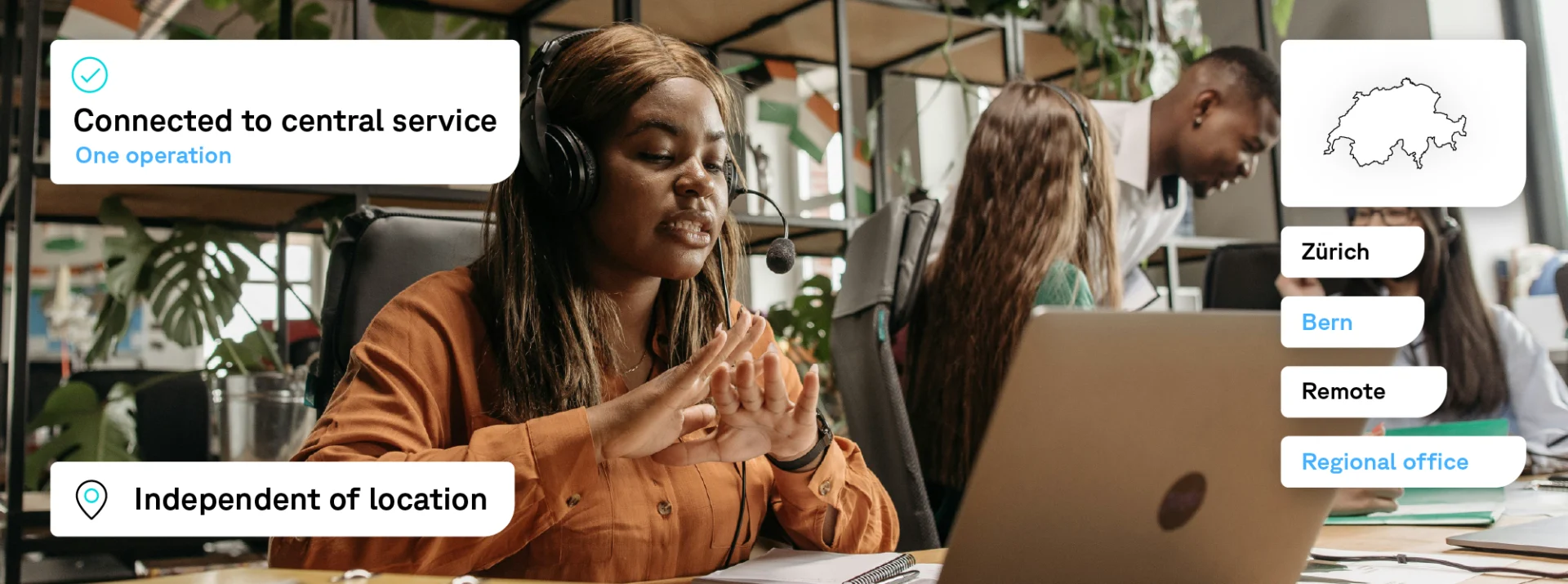
Many locations. One member service operation.

Statutory insurers, regional funds, and mutual organizations operate across dozens or hundreds of local offices. The contact center has to behave like one operation regardless of where any individual agent is sitting. Bucher + Suter delivers that as an end-to-end engagement rather than a platform handoff.

A health insurance contact center representative wearing a headset sits at a desk with an office team in the background, overlaid with information panels about central service, location independence, and locations in Switzerland.

Customer Story: Scaling operations fast with integrated voice and CRM

Testimonials wave
The text AOK next to a circular icon containing a stylized plant sprout, representing contact center performance optimization.

Case Study: AOK Nordost scales to 100 locations in 4 months

AOK Nordost is the largest statutory health insurance fund in Berlin, Brandenburg, and Mecklenburg-Vorpommern, serving 1.75 million members across more than 100 service centers. Bucher + Suter deployed Cisco UCCE with a redundant high-availability setup inside the AOK data center, integrated CTI into the AOK web-based CRM intranet, and runs ongoing operation and support of the voice contact center infrastructure as a managed service.

Read the AOK Nordost case study →
Testimonials wave
The text AOK next to a circular icon containing a stylized plant sprout, representing contact center performance optimization.

Andreas Fischer, Head of Customer Service, AOK Nordost

"Whether in the background or on-site, your uncomplicated, approachable manner and the speed at which you've delivered help have made a great impression on our colleagues in the contact center."
Read the AOK Nordost case study →

Webex Contact Center modernization without service disruption.

The migration to Webex Contact Center moves member service onto a scalable, AI-ready platform. It has to happen without surrendering the security and stability the on-prem environment provided. Bucher + Suter runs that transition end to end, including the Salesforce integration that keeps member context in front of every agent.

A smiling woman wearing a headset takes notes at her desk while using a connected contact center system in an office.

From Legacy to Cloud — Scaling Contact Center Operations

Testimonials wave
Helvetia logo consisting of a geometric icon to the left of the word helvetia in lowercase black text, representing a contact center transformation partner.

Case Study: Helvetia scales to 1.2 million annual calls

Helvetia is one of Switzerland's largest insurers, with 4,000 employees in Switzerland and contact center operations spanning four languages. Bucher + Suter led the migration from on-prem Cisco UCCE to Webex Contact Center across 2024 and 2025, including the integration of Salesforce (with Einstein AI moving to Agentforce), Microsoft Teams telephony, and a GPT-powered voicebot. New service units now launch in 1–2 days.

Read the Helvetia case study →
Testimonials wave
Helvetia logo consisting of a geometric icon to the left of the word helvetia in lowercase black text, representing a contact center transformation partner.

Andreas Fischer, Head of Customer Service, AOK Nordost

"Whether in the background or on-site, your uncomplicated, approachable manner and the speed at which you've delivered help have made a great impression on our colleagues in the contact center."
Read the Helvetia case study →

Audited against the standards keep member service compliant.

Latest resources for health insurance CX leaders

Practical insights on member service, AI, contact center operations, and digital transformation, helping health insurers improve experiences, increase efficiency, and deliver consistent support across every channel.

Frequently asked questions

Health insurers need contact center technology that connects member interactions with claims, coverage, CRM, and back-office processes. It should preserve member context across channels, route inquiries accurately, protect sensitive data, and support consistent service across locations.

Members may use phone, email, messaging, and other channels for different parts of the same inquiry. Connecting those channels with the underlying service processes helps preserve context, so members receive consistent support without having to repeat information.

Automation can handle routine requests such as eligibility checks when the process and data are reliable. More complex inquiries, including care-coordination escalations, can be routed to an employee with the relevant member and case context already available.

Recordings, CRM activity, and stored member communications need to operate within the applicable privacy and data-handling requirements. For European health insurers, that can include GDPR and national social-data laws, as well as controls governing where data is processed and stored.

A connected contact center can bring agents and service centers into one operating environment, regardless of location. Centralized availability, skill-based routing, supervisor visibility, and real-time reporting help the organization provide more consistent member service across regional offices.

Efficiency can come from better routing, connected systems, automation, forecasting, and scheduling rather than increasing pressure on agents. These improvements help employees manage inquiries more effectively while keeping the member experience at the center of the operation.

Yes. Moving from an on-premises environment to Webex Contact Center can be structured to preserve the security, stability, and service continuity of the existing operation. Integrations with systems such as Salesforce can also keep member context available throughout the transition.

CRM integration gives agents access to relevant member and case information within their working environment. This reduces system switching and helps agents continue claims, coverage, and other service conversations with more complete context.

Learn more about Bucher + Suter for health insurance

Contact us to see how our expert team can help.