Several of Cisco’s WebexOne announcements this month apply directly to contact center teams, on a timeline running from October into the first quarter of calendar 2027. One of the most significant is Dialog, an agentic CX harness anticipated to enter beta in Q1 27. Around it: a contact center MCP server, agent-to-agent coordination, observability through Splunk, and model and voice integrations from Google Cloud and NVIDIA.
Read the Cisco press release →
What Dialog tells us about the near future
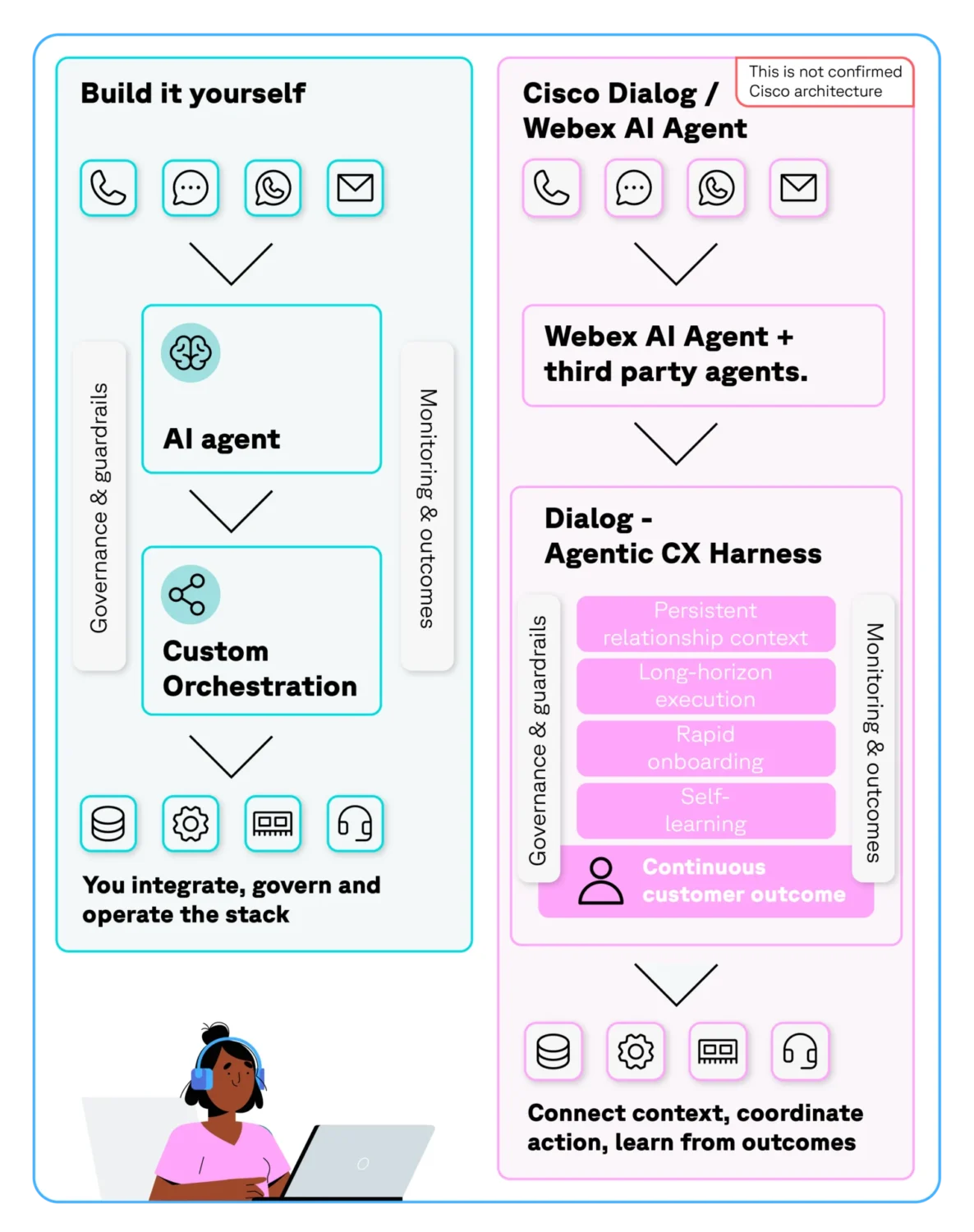
Cisco’s own framing is that Dialog powers the Webex AI Agent platform. Alongside it, a Webex Contact Center MCP server and agent-to-agent coordination open paths for AI tools and agents from outside the platform to reach into the contact center.
Cisco uses four capabilities to describe Dialog:
- Long-horizon agentic execution that continues after an interaction ends
- Persistent relationship context across “channels, teams, systems, and time.”
- Self-learning that refines performance against customer outcomes
- Onboarding of AI agents against existing knowledge bases
This is what “harness” looks like in practical terms. The quality of these connections decides what any agent can (or can’t) do.
Our reading is that Dialog orchestrates across both sides of that boundary, covering agents built on Webex AI Agent and agents reaching in through MCP. What the announcement leaves open is how much of this is new ground. An organization with a well-maintained CRM and disciplined workflow management can already get a long way toward agents that act across systems, especially with MCP in the picture. How much Dialog shortens that path is something the beta will show.
Then there’s the CRM. For human agents, it has been the source of truth, the record they work from and write back to. If orchestration runs through the contact center while Dialog carries its own persistent understanding of the customer across channels, teams, systems and time, two systems hold a version of that truth. Which one wins a disagreement, and which one an auditor reads, are worth settling before a beta becomes a deployment
We’ve argued before that unified customer identity and reliable data access determine whether multi-agent deployments work. This remains true however the above-mentioned questions are answered.
A protocol surface for the contact center
Going a layer deeper from the customer outcome orchestration of Dialog, the Webex Contact Center MCP Server connects external AI tools and agents directly to the contact center and allows configuration and workflow management in natural language. Agent-to-agent coordination follows in December, extending the same openness to agents working with each other. Google Cloud’s Gemini Enterprise integration is dated Q4 and NVIDIA’s Nemotron voice agents November, both bringing intelligence from outside Cisco into the platform.
Protocol support changes who can build against your contact center. An agent developed by another team, running on another vendor’s stack, becomes something you connect rather than something you re-platform around. That widens the design space, and it widens the governance surface by the same measure. Every connection is a decision about what reaches customer data and what it may do once it gets there.
Policy compliance presumes a policy
AI Agent 360 gains Agent Observability through Splunk, with general availability planned for December. Cisco’s description of its coverage runs to agent behavior, performance, policy compliance, and business impact.
Policy compliance asks more of an organization than meets the eye. Reporting compliance means measuring against a policy that exists, written down, specific enough for a system to evaluate. Which actions an agent may take without review, and what it may disclose before a person sees it, are decisions your organization makes and records. No observability layer arrives with those answers in it.
Some of that control surface is already documented. The Contact Center MCP server requires an administrator to enable it for the organization, and individual tools can be switched on or off from there. Granular control over what an agent reaches exists today. Somebody still has to decide the settings.
Long-horizon agents working after the call ends
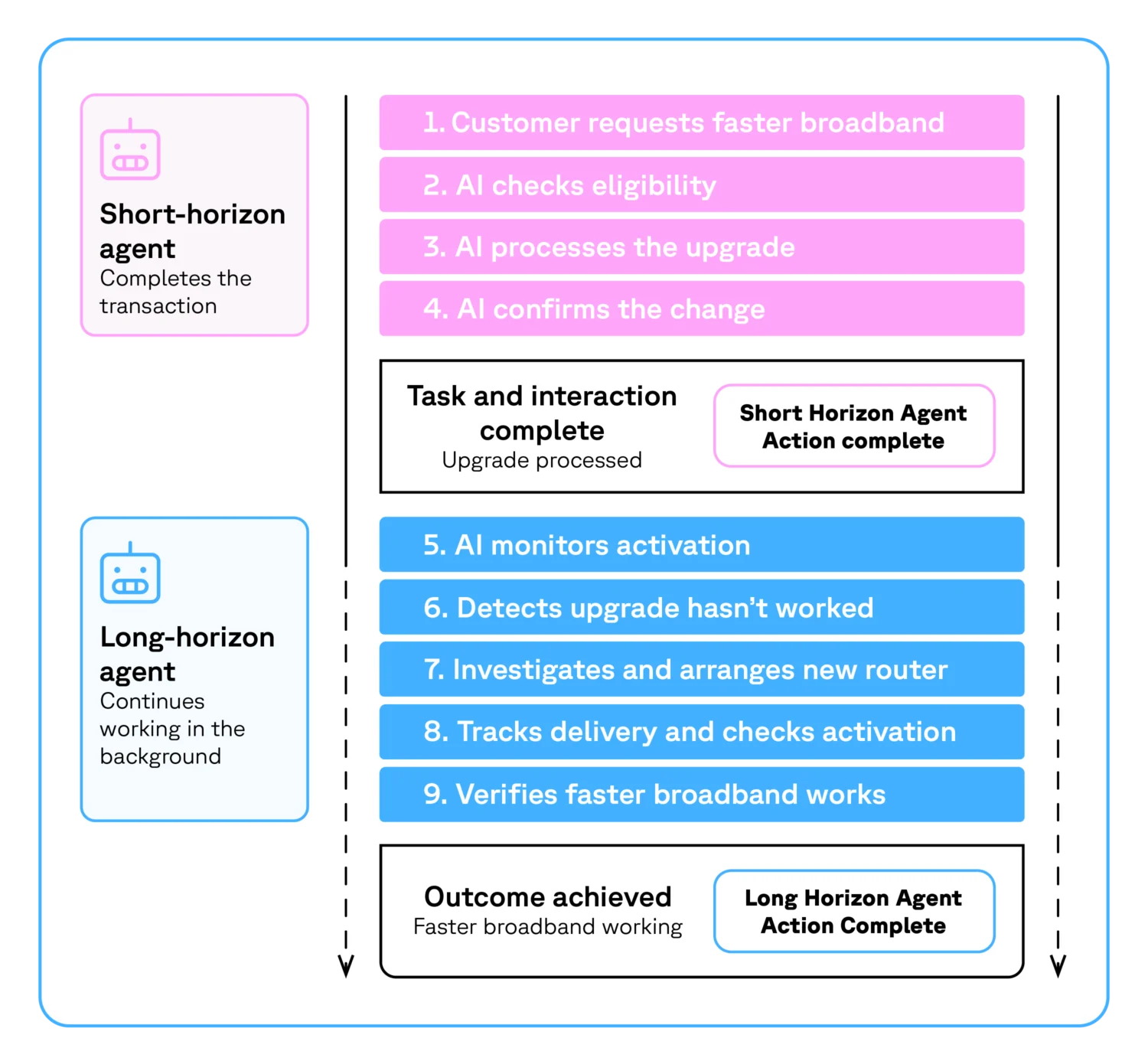
Of everything announced at WebexOne 2026, long-horizon execution agents perhaps carry the most significant operational consequence. A long-horizon agent continues working after the customer interaction ends. It does unattended work on your behalf.
Let’s say a customer requests faster broadband. A short-horizon agent checks eligibility, processes the upgrade, and confirms the change. The interaction ends there. A long-horizon agent keeps working in the background, monitoring activation, resolving any problems that arise, and ultimately verifying that the customer’s faster broadband is working.
That kind of semi-autonomous handling raises questions that most quality programs weren’t designed to answer, starting with which outbound messages need human approval before they reach the customer and what the agent is permitted to promise on your behalf.
Cost belongs on that list. An agent working a case for three days consumes tokens and token calls throughout, against a contact that used to close or escalate inside a single conversation. Across a queue, that bill changes.
The WebexOne announcements don’t address how long-horizon work gets metered, though AI Agent 360’s stated coverage includes business impact, and Cisco’s September Splunk announcement included a Tokenomics capability for tracking AI token spend. Whether that reaches contact center agents is unstated.
What does an economic control plane look like for agents that run for days, and who gets alerted when one runs long? AI spend is only as predictable as your controls argued that predictability comes from controls somebody puts in place after launch. Long-horizon execution raises the stakes on that.
Escalation design is already a more demanding part of AI deployment when the handoff happens inside one conversation. Work that spans days asks more of it.
Persistent context that depends on systems Cisco doesn’t own
Persistent relationship context, in Cisco’s description, unifies customer history with enterprise data across channels and time. The question is, what condition is your enterprise data in?
A harness functions around whatever your systems make available. When order history lives in an ERP that was never connected, for example, or when Tuesday’s chat never reached the customer’s record, the continuous relationship has gaps in it. An agent reasoning over that view will answer with full confidence, but from a partial picture.
None of that work waits on Dialog, and none of it gets easier by waiting. An integration review that maps which systems feed the customer record, and which don’t, is available to start this quarter.
Release roadmap: What you can deploy now
Dates below come from Cisco’s announcements, with the usual caveats on pre-release schedules.
- Webex AI Agent for CCE is generally available for Contact Center Enterprise. Cisco plans to extend Webex AI Agent for Voice to Contact Center Express in October 2026.
- Webex Contact Center MCP Server is currently in beta, with general availability planned for October 2026.
- NVIDIA Nemotron voice: November 2026.
- Agent observability and agent-to-agent coordination: December 2026.
- Gemini Enterprise integration: Q4 2026.
- Dialog enters beta in Q1 2027
- Universal Harness on-premises: Q1 2027.
We read the last bullet (Universal Harness) as the layer that lets different AI engines run inside the Webex suite, a bring-your-own-AI foundation that has been described for some years. Dialog’s description centers on orchestrating multiple agents concurrently, which is a different job.
The near-term items are connections and controls. The platform change that the keynote was built around is a year out. A 2027 roadmap resting on Dialog needs a 2026 workstream underneath it, and that workstream is integration and data readiness.
Talk to us about what connects to your contact center.