
In the EU and the U.S., the accessibility rules behind government websites also extend to the contact center. Citizens using screen readers, for example, should be able to use the phone line or web chat the same way they can on the main site.
What’s missing in the contact center is the oversight. A public body may have to publish a required accessibility statement for its website and submit to regular monitoring by a designated national body, but the contact center doesn’t. By and large, no one checks whether it meets those rules at all. Contact center accessibility depends entirely on how the operation runs. Because contact center operations change constantly, accessibility tends to slip.
A public-sector contact center that stays accessible as it changes keeps essential public services within reach of everyone who needs them. Both in Europe and in the U.S., governing bodies specify what that takes.
In the EU, EN 301 549 governs accessibility for ICT products and services. It’s the harmonized standard that turns Web Content Accessibility Guidelines (WCAG) into procurement-binding requirements. It reaches well beyond web pages to a contact center’s phone system. The U.S. has Section 508 for federal agencies and the 2024 ADA Title II rule for state and local government.
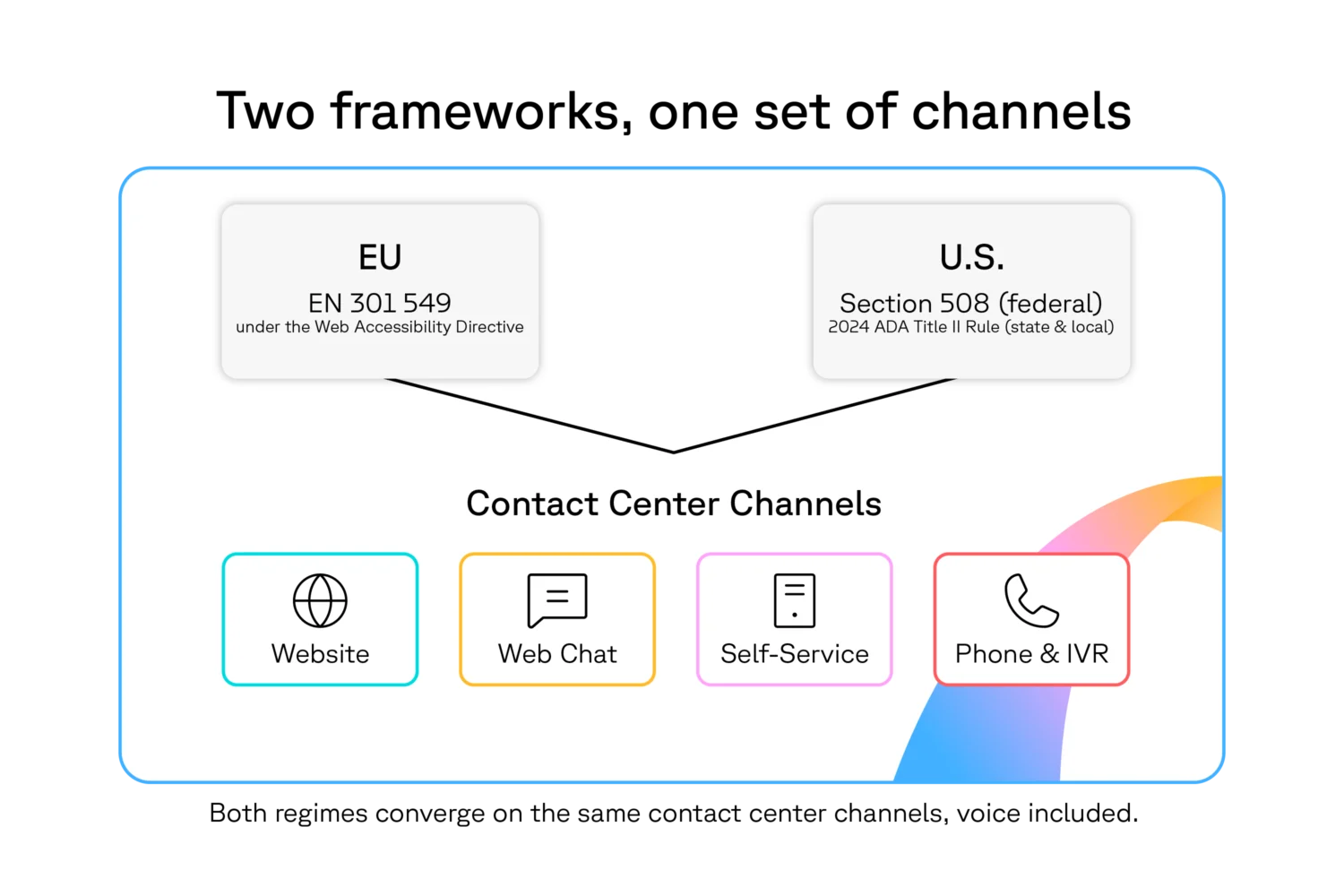
Both frameworks underscore a similar reality: a public service is accessible only when a citizen can finish what they came to do through the channel they chose, be that phone, web chat, the website, or otherwise. Meeting that standard of accessibility in the contact center, and keeping it met as the service evolves, starts with what those frameworks require of each channel.
The Voice Channel Has Accessibility Requirements of Its Own
EN 301 549 sets requirements directly for two-way voice communication. Where a voice service runs an IVR or auto-attendant, a caller must reach the same information and finish the same task without relying on hearing or speech, with real-time text available during a live call.
Section 508 specifies the same in the U.S., through a two-way voice communication clause that federal contact center systems have to meet. Self-service portals and web chat, meanwhile, answer to the WCAG baseline that governs the rest of the site.
That’s the working scope of a compliant contact center. A citizen who can’t use a voice menu still needs a way to resolve their request. A relay call routed to your center has to connect and stay connected whether or not anyone tested that path lately. In public service, the contact center is often the only way to reach an essential service, and the people who use it span every access need there is. In the EU alone, close to one in four adults live with a disability.
A Launch Audit Certifies One Service Moment that Runs Every Day
This is where public-sector accessibility programs tend to degrade. Let’s say an agency commissions an audit, remediates, and publishes an accessibility statement. They’ve checked the accessibility box, but the accessibility audit was accurate on the day it ran. When a team ships a new voicebot flow, or reroutes a queue to a different skill group, those changes may never go back through the same scrutiny. As a result, accessibility weakens, and the people it fails are the least likely to have an easy alternative.
Treating conformance as an operating requirement, checked as the service evolves rather than at a single milestone, is what separates an accessibility statement you can stand behind from one that describes your contact center in the past tense.

Accessibility Fails at the Handoffs Between Channels
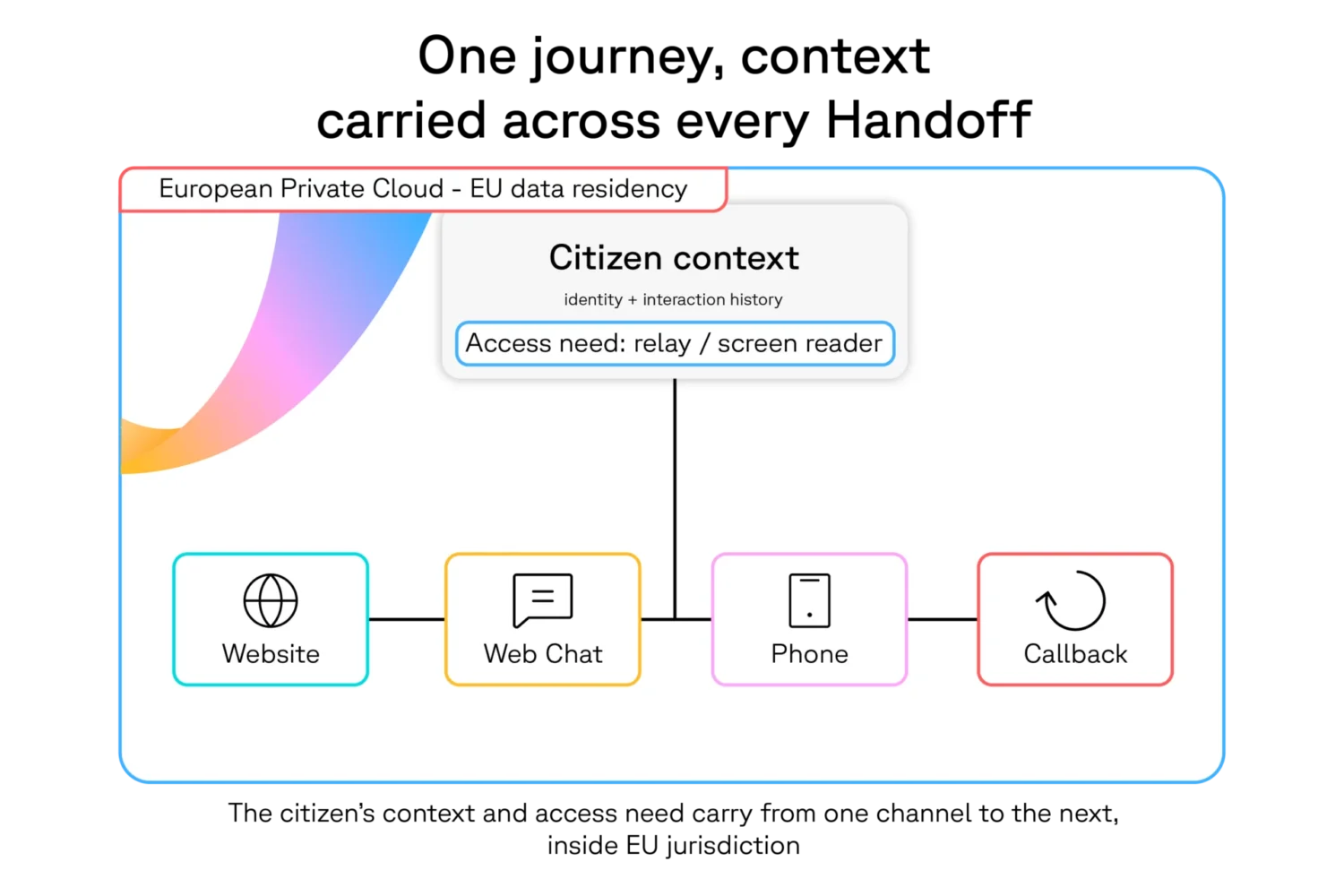
Here’s a common occurrence in public-sector contact centers: a citizen starts on the portal with a screen reader, can’t finish, and calls in for help. The agent has no view of what they already tried. The call gets escalated, a callback is booked, and the accessible context from the first channel is gone. This is a great example of how each individual channel may meet accessibility standards, while the journey across them still creates friction for the person who needs help.
This is an integration problem, which is why it rarely surfaces in a component-level audit (and rarely gets written into a procurement spec as a cross-channel requirement). An accessible experience that reaches across channels depends on the channels being connected in the first place, so that context and the citizen’s chosen way of communicating carry from one step to the next.

How Bucher + Suter Keeps Accessibility Top of Mind
Through Managed Services, the changes that would otherwise erode accessibility get handled as part of running the platform rather than shipped and forgotten. We’ve operated this way in mission-critical public service for a long time.
Most notably, Bucher + Suter has run Swiss Post’s contact center since 1999 and evolved it across more than two decades, from real-time monitoring and omnichannel routing to conversational AI in Swiss-German and a move to cloud, without breaking the reliability citizens count on. Swiss Post’s own summary of the partnership is that it just works. The same model runs behind our contact center operations in both European and U.S. markets.
The integration side is where we connect the whole system. Through CRM integration and digital channels tied into one routing model, a citizen’s context and chosen channel carry across the journey, so an accessible experience on one channel doesn’t collapse at the handoff to the next. For public bodies with data residency obligations, our European Private Cloud keeps that operation inside EU jurisdiction.

How Urgent is Accessibility Compliance?
The timing pressure is real on both sides of the Atlantic. In the EU, the European Accessibility Act has been enforceable since June 2025, and public-sector monitoring under the Web Accessibility Directive runs on its regular cycle. In the U.S., the Department of Justice extended the ADA Title II web deadlines in April 2026, giving state and local governments until April 2027 or April 2028 depending on size. Section 508 continues to govern federal ICT.
These deadlines favor the public bodies that keep accessibility current as the operation changes, because the next change is always coming.

Start Prioritizing Contact Center Accessibility Now
Compliance comes down to a contact center that still works for every citizen the day after your last change went live. If you want to pressure-test your accessibility, talk to an expert.