
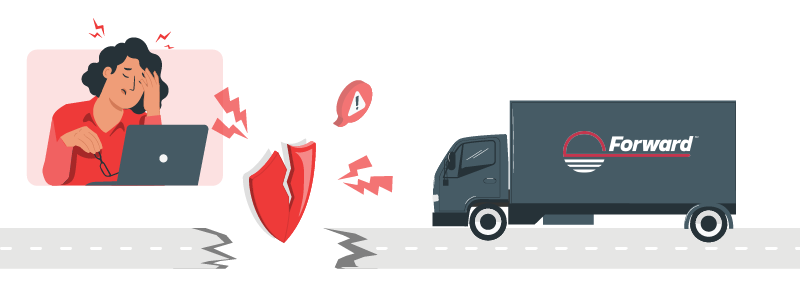
Ransomware is a constant threat in transportation and logistics. A recent ransomware attack collapsed a 158-year-old UK transport company. Forward Air and its 6,500 employees faced their own ransomware moment shortly before the COVID-19 pandemic. It completely disrupted operations for a month.
All of this amid a wholesale overhaul of the company’s legacy IT and communications infrastructure. Fast forward to the present day: Forward Air has completed an ambitious project that initially seemed sure to stall. The new environment has led to $40K in monthly savings.
Here’s a look at how Senior Network Engineer Ramon De La Cruz and his team did it.
Forward Air Corporation is a leading provider of ground transportation and logistics services to the North American air freight and expedited less-than-truckload (LTL) market. They’ve been operating since 1990, with over 90 facilities located at or near major U.S. and Canadian airports.

| 6,500+ employees with 1,700+ dependent on collaboration technology | 90+ facilities and 12 regional sort centers | Time-sensitive freight delivery commitments | Eliminated dropped calls, standardized infrastructure | Modernizing infrastructure to cloud-based unified communications |

Navigating the Challenges of a Multifaceted Migration
The ransomware attack was just the beginning. It was followed by the COVID-19 pandemic, which intensified strain on Forward Air’s aging infrastructure. Then Forward Air’s provider delayed its planned Packaged Contact Center Enterprise (PCCE) deployment and by mid-2020, Forward Air still lacked virtual machines for the environment.
De La Cruz and his team decided to pivot to Webex Contact Center. It was the most viable path to overcoming significant infrastructural challenges, namely:
- Fragmented phone systems across locations (ShoreTel, RingCentral, various providers)
- Employees couldn’t dial between terminals
- Overloaded SIP trunks causing dropped calls and garbled audio
- Issues with inbound call handling (dropped calls, busy signals)
- Legacy systems with zero documentation
Support teams were often tied up by spot crises. Customer and employee experience suffered. And constant turnover among IT leadership prevented much needed standardization. Eventually, the operational risks outweighed the benefits of maintaining the status quo.
De La Cruz states:
“We needed to migrate everything to a globalized enterprise voice system, something unified across terminals and sites that our staff could use to communicate more efficiently. That was the goal.”
Along the way, De La Cruz and his team discovered a number of auxiliary issues that needed attention before the migration could move forward. Many Forward Air sites lack required floor plans, for example, triggering a separate site survey project. UCCX call flows still needed proper documentation. And, unbeknownst to De La Cruz at the time, his managed services provider would abruptly exit the Cisco Hosted Collaboration System (CHCS) business, forcing Forward Air to shift to Cisco Direct Integration.

Pivoting to Webex Contact Center
De La Cruz led Forward Air’s transition to a cloud-based platform that replaced the patchwork of legacy systems. Their goal was to enable seamless communication across all locations, primarily by way of Webex Contact Center and Webex Calling.
The implementation included: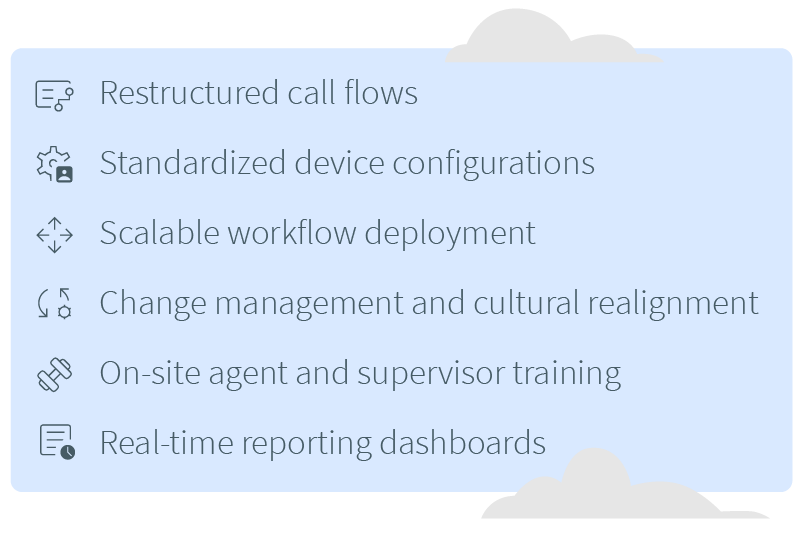
The team implemented new Webex features such as Courtesy Callback, Estimated Wait Time, and RONA tracking. This shift not only resolved long-standing technical challenges but laid the foundation for continuous innovation—including plans to:
- Integrate Webex with Salesforce Service Cloud Voice
- Expand into new digital engagement channels
This implementation required meticulous coordination across 90+ facilities. De La Cruz and his team executed site-by-site migrations, prioritizing high-tonnage terminals first and deploying comprehensive user acceptance testing protocols. They addressed complex infrastructure challenges including analog integration for dock speakers, ATA configurations for legacy equipment, and certificate management across multiple cluster environments.
They migrated from CHCS platform to Cisco DI without losing a single phone number.
STAY UP TO DATE

Moving Forward on Solid Footing
The transformation delivered immediate operational impact: $40,000 in monthly licensing cost reductions, elimination of dropped calls and SIP congestion issues, and standardized infrastructure that significantly reduced support overhead.
|
Timeline |
~4-5 years from inception to full deployment |
|
Scale |
90+ facilities, 6,500 employees, 1,700+ collaboration users |
|
Financial |
$40,000 monthly savings in licensing costs |
|
Organizational |
Zero phone numbers lost, eliminated dropped calls, standardized infrastructure |
New capabilities, such as the adoption of real-time reporting dashboards, created a culture of visibility and accountability. Teams that were previously resistant to change began to engage with performance data and optimize their operations.
Supervisors now track queue performance, RONA trends, and abandoned calls through Webex Analytics. These tools have not only improved customer satisfaction but also boosted employee morale, setting the stage for further innovation through deeper integration with Salesforce and ongoing investment in AI-powered capabilities.
Moving forward, Forward Air plans to deploy 6800/8800/9800 series desk phones across the organization, alongside expansion into SMS/MMS and digital engagement channels. They’ve also tapped Bucher + Suter Managed Services for their cloud migration of Webex Calling.
As the next phase of the program, all DID numbers will be migrated to Cloud Connected PSTN, with completion planned for January 2026. From Q1 2026 onward, the focus will shift to migrating all non WxCC locations from DI to a Multitenant environment.

Our goal is to help Forward Air maintain resilient infrastructure that scales with growth.
If you’ve got a large legacy unified communications and CX platform migration of your own, Bucher + Suter can help. Contact us to learn how.