


AI is permeating what was until recently the work of human customer service agents: voice interactions. Today, close to all organizations use some form of voice technology in their operations, with 67% viewing voice AI as foundational to their business strategy (Deepgram 2025 State of Voice AI Report).
With Cisco Webex AI Agent now joined by Agentforce Voice, there are multiple options when it comes to autonomous voice agent technologies. There’s also a choice between full automation or human-enhancement strategies. So, the question becomes where do you start? Both paths are viable: end-to-end automation (i.e., AI-led autonomous voice agents handling complete interactions) and human-agent enhancement (i.e., human-centric voice AI augmenting human agent processes). But the one you prioritize first will define your transformation.
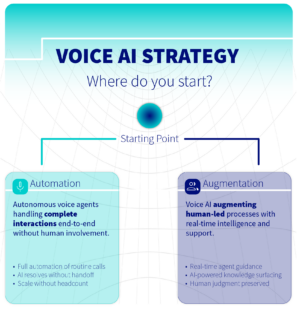
Most organizations will walk both paths. The one you prioritize first defines your transformation.
In this blog post, we’ll contextualize the arrival of Agentforce Voice within the broader contact center conversation. Because despite the tendency to reactively adjust strategy in response to emerging tech, approaching the replace-and/or-enhance conversation deliberately may be more prudent.
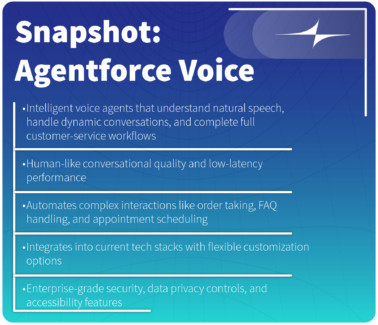

What end-to-end voice interaction automation actually means
Let’s say a business traveler needs to change their flight departure time while rushing through an airport. They call the airline’s voice line and within 30 seconds, the AI agent:
- Confirms the passenger’s identity
- Presents available alternative flights
- Processes the rebooking
- Sends the updated boarding pass
- Confirms the change
… all through natural-voice conversation.
It’s an attractive use case for complete interaction ownership—AI handling customer queries from start to finish without human intervention—especially for large airlines that handle a high volume of these calls every day.
The potential upside is considerable: Gartner projects that conversational AI will reduce contact center labor costs to the tune of $80 billion by 2026. Available 24/7, AI voice agents can handle unlimited concurrent conversations, effectively eliminating the need for surge staffing.
But the upside comes with caveats:
Use-case limitations exist
While autonomous voice agents excel at information retrieval, transactional tasks, and routine problem-solving, they may struggle with complex empathy-driven scenarios, nuanced complaints requiring judgment calls, and situations where customers specifically demand human interaction.
Customer acceptance is conditional
Although a growing number of consumers now accept AI agents for most customer service calls, there’s a catch: the AI must demonstrate clear comprehension and natural responsiveness. Customer tolerance for any issues, failures, or errors is quite limited. And today, only 30% of consumers say AI has made getting customer service assistance better.
Escalation protocols matter
Smart deployment includes clear handoff triggers: when customers explicitly request human assistance, AI confidence drops below threshold levels, or issues require empathy-driven resolution. The most successful implementations achieve high containment rates while maintaining seamless escalation pathways for the ‘uncontained’ cases.
Integration complexity varies
While some organizations deploy voice AI within 30-60 days using cloud-based platforms, enterprise implementations requiring CRM integration, compliance protocols, and custom workflows often extend beyond 90 days. The key success factor isn’t deployment speed but ensuring the AI agent can access necessary systems and data to complete end-to-end resolutions.
Put simply: data strategy precedes AI strategy.
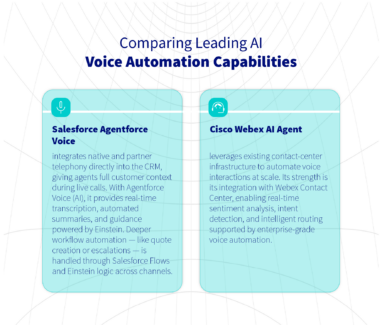
That covers the automation side. What about AI that keeps humans in the loop?

Going the ‘enhancement’ route
A customer calls frustrated about a delayed package for a time-sensitive gift. As the human agent greets them, AI instantly surfaces:
- Complete order history
- Previous support interactions
- Current shipment status
- Three resolution options ranked by likely customer satisfaction.
The agent expresses genuine empathy, explains the delay, and—seeing the customer is a high-value repeat buyer—uses the AI-suggested option to expedite a replacement at no charge. The interaction takes four minutes, costs little in terms of labor, and turns a potential detractor into a promoter.
In this human-centric deployment, AI provided speed while the human provided judgment. Having had more time to evolve in the contact center space, enhancement tech has established business impact, including reduced average handle time, increased satisfaction and retention, and faster agent onboarding time.
One of the key advantages of human-enhancing voice AI is skills amplification, of which we have numerous examples:
- Real-time coaching and suggested responses
- Instant access to resolution protocols
- Automated sentiment analysis
- Live conversation summarization
- Cross-sell/upsell intelligence
- Post-call work automation
The enhancement approach acknowledges a fundamental reality: while AI excels at information processing and pattern recognition, it can’t replace everything that humans do. People excel at empathy, creative problem-solving, and building relationships.
In addition, enhancement has a few other advantages:
Agent buy-in
When positioned correctly—i.e., AI is presented as support rather than replacement or surveillance—human service agents tend to have few qualms accepting the role of this tech in their daily roles. All the better if those agents can see the tangible benefits, which can include reduced After Call Work (ACW) and faster time to proficiency.
Skills evolution becomes an advantage
As AI handles routine information retrieval and documentation, successful agents develop deeper expertise in emotional intelligence, creative problem-solving, and relationship management. These uniquely human capabilities become more valuable in an AI-augmented environment, creating clear career progression paths that improve retention.
Lower-risk path to AI adoption
Organizations can implement augmentation tools incrementally, measure impact, and scale gradually. This can reduce integration complexity and customer experience risks that come with full replacement strategies. For contact centers balancing efficiency gains with service quality, enhancement provides a proven bridge between current operations and future AI capabilities.
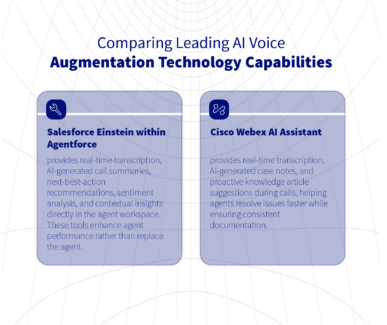

What vendor strategies reveal about AI’s future
Salesforce’s investment in Agentforce Voice signals strong confidence in replacement capabilities, positioning voice AI as capable of handling complete customer workflows, on top of the already existing robust agent augmentation capabilities of Einstein. Cisco, too, has taken a balanced stance, architecting Webex to support both paradigms: autonomous agents for routine interactions and robust augmentation tools for human agents.
The strategic tradeoffs are clear. Complete automation-focused solutions offer immediate cost advantages but risk customer experience degradation if implementation falters. Augmentation-first platforms maintain service quality but may struggle to achieve the scale benefits of full automation.
In terms of your organization’s path, consider the following:
Process maturity determines AI viability
Organizations with highly standardized, well-documented processes can more easily deploy autonomous agents, while those with complex, relationship-dependent workflows benefit more from augmentation strategies that preserve human judgment and flexibility.
Brand positioning must align with voice AI strategy
Premium service brands risk diluting their differentiation by over-automating, while efficiency-focused organizations can leverage full automation as a competitive advantage. Always match your AI approach to brand promise and customer expectations.
Successful implementations adopt channel differentiation
That is: autonomous agents handle routine inquiries while augmented humans manage complex cases. This tiered approach optimizes cost efficiency without sacrificing service quality for high-value interactions requiring empathy and creative problem-solving.

Let customer preference be the guide
Experience consistently outweighs efficiency in customer preference research. While customers accept AI for simple tasks, they expect seamless escalation to humans for complex issues and demand that AI interactions feel natural and contextually aware. Failed AI implementations create lasting negative brand perceptions. And today, 95% of GenAI pilots fail to deliver measurable business impact.
The choice facing organizations is immediate and strategic.
AI is a means, not an end. The most effective implementations—whether replacement or enhancement—still deliver superior customer outcomes while creating sustainable competitive advantages that extend far beyond technology alone.