


Cisco announced it. Salesforce is shipping it. Google donated an open protocol to the Linux Foundation. Multi-agent orchestration is the next frontier in contact center AI, with vendors promising AI agents that collaborate across systems to resolve complex customer issues autonomously.
The vision is compelling: a customer calls about a billing dispute, and instead of bouncing between departments, multiple AI agents work in parallel. One authenticates. One retrieves billing data. One checks CRM history. One processes the resolution.
Here’s the problem.
According to Calabrio’s State of the Contact Center 2025 report, which surveyed over 400 global contact center leaders:
- 30% cite poor system integration as a major barrier to realizing value from AI
- Only 36% have achieved true omnichannel integration
- 98% are now using AI in some form, but 20% say challenges outweigh benefits
If your systems can’t share data reliably today, adding more AI agents won’t fix that. Multi-agent orchestration doesn’t solve integration problems. It amplifies them.
This post explains what multi-agent orchestration actually means, what’s shipping now versus what’s roadmap, and why the path to orchestration runs through single-agent automation first.

What Multi-Agent Orchestration Actually Means
Multi-agent orchestration refers to multiple specialized AI agents working together on a shared goal. In the context of the contact center, each agent accesses different systems or data sources, and they coordinate to complete tasks that no single agent could handle alone.
This is different from single-agent automation, where one AI agent handles an interaction from start to finish, typically within a single system or channel. Most contact centers today, if they’ve deployed AI agents at all, are operating at this level.
The technical infrastructure making orchestration possible involves two protocols:
Agent-to-Agent Protocol (A2A)
Originally developed by Google and now hosted by the Linux Foundation as an open-source project, A2A enables AI agents to discover each other, negotiate how they’ll communicate, and collaborate without exposing their internal logic or data.
Google unveiled the specification in April 2025, and it now has support from over 150 organizations, including Salesforce, SAP, ServiceNow, and Cisco. A2A allows agents built on different platforms to work together, which matters in enterprise environments where you’re unlikely to standardize on a single vendor.
Model Context Protocol (MCP)
Introduced by Anthropic, MCP standardizes how AI agents connect to tools, APIs, and data sources. If A2A is the language agents use to talk to each other, MCP is the language agents use to talk to the systems they need to access.
These protocols are complementary. MCP enables an agent to query your CRM or billing system; A2A enables that agent to hand off context to another agent that specializes in payment processing.
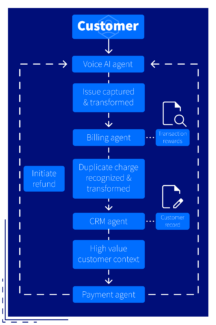
Here’s what this looks like in practice:
A customer calls about a billing discrepancy. Under multi-agent orchestration:
- A Voice AI Agent handles the call, authenticates the customer, and captures the issue
- Via A2A, it passes context to a Billing Agent that retrieves transaction records via MCP
- The Billing Agent discovers a duplicate charge and passes this finding to a CRM Agent
- The CRM Agent checks customer history, identifies this as a high-value account with a service guarantee, and notes this context
- A Payment Agent processes the refund
- If escalation is needed, the Voice Agent hands off to a human with full context intact
Each agent does one thing well. The orchestration layer coordinates the handoffs.

What’s Actually Shipping
Vendor announcements and production-ready features are two different things. Here’s the current state.
Cisco Webex AI Agent
Cisco announced support for A2A and MCP protocols in September 2025, with multi-agent collaboration capabilities slated for Q1 2026. The goal: enabling Webex AI Agents to work alongside agents from other vendors and access diverse enterprise applications through standardized protocols.
What’s available now? Single-agent automation with measurable results.
Three examples from the Cisco Webex Blog:
- CarShield deployed a pre-call screening agent that now resolves 66% of incoming calls without requiring a human representative
- BancFirst reduced abandoned calls by 10% and cut average issue resolution time by three minutes
- Bucher + Suter customer, Valeris achieved a 95%+ speech recognition match rate for complex pharmaceutical terminology and saw a 35% decrease in support tickets.
These results come from single-agent deployments, not multi-agent orchestration. That’s worth noting.
Related: Cisco just announced Webex AI Agent
Salesforce Agentforce
Salesforce is positioning Data Cloud as the unified data foundation for multi-agent workflows, with Agentforce agents serving as the orchestration layer across Service Cloud. Salesforce is also a founding contributor to the A2A protocol, signaling commitment to interoperability with non-Salesforce agents.
The Pattern
Notice what’s actually available versus what’s announced. Single-agent automation is shipping and producing results. Multi-agent orchestration with A2A/MCP support is roadmap for early 2026.
This indicates that vendors are building in the right sequence:
- Prove single-agent automation works
- Layer on orchestration capabilities
The question is whether organizations are doing the same.

Why Single-Agent Automation Comes First
Multi-agent orchestration sounds more impressive than “we automated our pre-call screening.” But the organizations finding success with agentic AI are the ones that got single-agent deployments working first.
Here’s why this sequence matters:
You need to prove AI agents can access your data before connecting multiple agents. If your CRM data is incomplete, or your billing system requires manual workarounds, those problems don’t disappear when you add orchestration. They multiply. A single AI agent making confident wrong decisions is manageable. Multiple AI agents passing bad data to each other at scale is a potential support catastrophe.
You need to establish trust before adding complexity. Gartner’s forecast is sobering: by 2027, they expect over 40% of agentic AI initiatives to be abandoned. One reason: organizations underestimate the change management required. Supervisors need to trust AI agent decisions before they’ll let multiple agents coordinate autonomously. That trust comes from watching single-agent automation succeed in contained use cases first.
You need the analytics to course-correct. How do you know if your multi-agent system is making good decisions? You need instrumentation. You need baseline metrics from single-agent deployments. You need to understand where handoffs fail before you add more handoffs.
The Integration Foundation Most Contact Centers Lack
Multi-agent orchestration assumes something that most enterprises don’t have: systems that can actually share data in real time.
Here’s what orchestration requires:
- Unified customer identity across systems
- API-first architecture
- Data governance for AI agent access
- Real-time data synchronization
A Crawl-Walk-Run Approach
The problem isn’t that information doesn’t exist. The chief problem facing contact centers is that information scattered across systems that don’t talk to each other. Multi-agent orchestration doesn’t fix this. It requires you to fix it first.
Here’s a practical sequence:
Crawl: Single-agent automation for contained use cases
Pick a high-volume, low-complexity interaction. Pre-call screening, for example. Appointment confirmations. Deploy a single AI agent and then measure containment rates, customer satisfaction, and error rates. Learn where the agent fails and why.
The CarShield example is instructive: their pre-call screening agent resolves 66% of calls autonomously. That’s a meaningful result that demonstrates AI can access the data it needs and make reliable decisions. It also reveals the 34% of calls where human intervention is still required, which is valuable information for designing escalation paths.
Walk: Add agent assist capabilities that access multiple systems
Before connecting multiple autonomous agents, empower human agents with AI assistance that pulls from multiple data sources (real-time guidance, suggested responses, etc.). This builds the integration infrastructure you’ll need for orchestration while keeping humans in the decision loop.
It also surfaces integration problems in a lower-stakes environment. If your agent assist tool can’t reliably pull payment history alongside support tickets, you’ve identified a gap to address before AI agents try to coordinate across those systems.
Run: Multi-agent orchestration for complex scenarios
Once you’ve proven single-agent automation works and built the integration layer for multi-system access, you’re positioned for orchestration. Start with scenarios where the complexity justifies the investment: high-value interactions, compliance-heavy processes, multi-department resolutions.
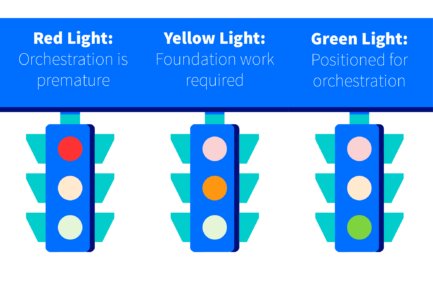
Red Light: Orchestration is premature
- Legacy on-premises contact center infrastructure
- No unified customer data strategy
- Basic system integration issues still unresolved
- Siloed IT and CX organizations
Yellow Light: Foundation work required
- Hybrid on-premise/cloud environment
- Multiple CRM instances or persistent data silos
- Single-agent automation in pilot but not scaled
- Limited internal capability to manage AI systems
Green Light: Positioned for orchestration
- Cloud-native contact center platform already operational
- Unified customer data layer with real-time access
- API management infrastructure in place
- Single-agent automation already deployed and performing well
- Strong cross-functional collaboration between IT, CX, data, and security teams

The Bottom Line on A2A (for Now)
Multi-agent orchestration is real, protocols are standardizing, and vendors are investing. By late 2026, organizations with the right foundation will be deploying AI agents that collaborate across systems to resolve complex customer issues.
But the competitive advantage won’t go to who deploys orchestration first. It will go to who builds the integration foundation that makes orchestration actually work.
That’s a different kind of project that’s less exciting than announcing a multi-agent pilot, but more valuable than chasing a capability your infrastructure can’t support.