


Global enterprise software spending likely hit $1 trillion in 2025. It turns out that a significant portion of that investment is going to waste. Zylo’s 2025 SaaS Management Index, which analyzed over 40 million licenses and $40 billion (US) in spend, found that 52.7% of purchased SaaS licenses sit idle.
The average organization wastes $21 million annually on software it never fully uses.
The problem rarely starts with technology alone. It starts with what organizations are sold on vs. what they need in operational reality. That misalignment between tech and challenges/outcomes tends to magnify how software is (or isn’t) utilized after the purchase order is signed.

What Software Underutilization Actually Looks Like
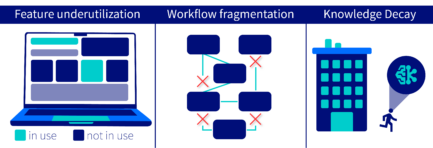
Underutilization shows up quietly, in three overlapping patterns.
- Feature underutilization
Teams default to the basics and never progress beyond them. They log cases, route calls, and pull reports. Meanwhile, the advanced capabilities that justified the platform’s cost (for example, analytics, automation, and AI-assisted workflows) sit untouched.
Reporting is a good example. A contact center platform may ship with a full analytics and intelligence suite, but if the suite requires custom configuration to surface actionable data, most teams default to the same three or four standard reports. Supervisors end up pulling data manually or building side spreadsheets because the dashboards they actually need were never set up.
We see this quiet reality playing out on the frontlines. According to Salesforce, for example, 42% of sales reps feel overwhelmed by too many tools. Eighty-four percent of sales teams without an all-in-one platform plan to consolidate their technology. When teams are overwhelmed by tools, they’re not exploring the advanced capabilities of any one of them.
- Workflow fragmentation
Instead of using what they have, teams build workarounds. We’ve all been on teams using separate spreadsheets for tracking, side-channel communications, or manual processes that the platform was built to automate.
Or consider the agent desktop. Without proper integration between the contact center platform and the CRM, agents toggle between systems to look up customer history, log interactions, and manage call controls. The CRM has the data. The contact center has the routing. But if the middleware connecting them was never fully configured, agents build manual workarounds that add seconds to every interaction and minutes to every shift.
Statista reports that the average organization now subscribes to roughly 130 different tools. It’s more than likely that this overlap exists because core platforms were never fully adopted in the first place.
- Knowledgedecay
Even when initial training goes well, turnover and platform updates create a widening gap between what the software can do and what your teams know how to do. Prosci’s longitudinal research shows that initiatives with excellent change management are six to seven times more likely to meet their objectives. When change management ends at go-live, so does the momentum.
The contact center is far from immune to this trend. Deloitte Digital’s 2026 Global Contact Center Survey found that while 64% of service leaders report higher agent productivity from AI investments, only 48% of organizations with mature service capabilities are actually using agentic AI, dropping to 24% among less mature peers.
If adoption and enablement strategies don’t match the technology investment, the cycle repeats: new platform, same underutilization, same pressure to upgrade again in two to three years.

Why This Keeps Happening
Insufficient training is a factor here; but it’s more of a symptom than a root cause. The structural reasons run deeper.
The project mindset.
Most enterprise software deployments are managed as projects with a defined end date: procurement, configuration, go-live, close. Adoption and optimization require a program, one that runs continuously, with dedicated ownership, measurable KPIs, and executive sponsorship that extends well beyond the initial rollout. When the project team disbands after launch, nobody owns what comes next. And what comes next is where the value either compounds or erodes.
Vendor incentive gaps.
Software vendors are built to sell licenses and expand seats. The business case for helping existing customers fully adopt what they’ve already purchased is less obvious to the vendor than upselling the next tier or add-on. This creates a gap that somebody needs to fill. It usually falls to the customer, often without the dedicated resources or platform-specific expertise to do it well.
The “good enough” trap.
When a platform is partially adopted and partially working, there’s rarely a crisis that forces action. Teams adapt. Leadership doesn’t immediately see the ROI case (the one that justified the purchase in the first place) quietly eroding.

From Deployment to Realized Value
Solving the utilization problem requires shifting from a deployment mentality to a value-realization mentality. In the field of software utilization, value-realization entails:
Outcome mapping before and after implementation.
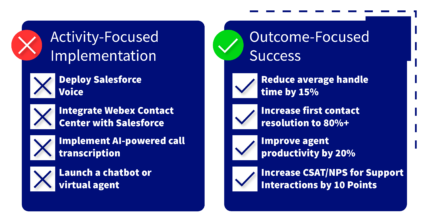
Define success in business terms, not platform terms. “Reduce average handle time by 15%” is an outcome. “Deploy Service Cloud Voice” is an activity. When you start with the outcome, you can measure whether the platform is actually delivering. When you start with the activity, you measure completion and move on.
Continuous enablement.
This may mean quarterly business reviews that audit feature adoption against stated outcomes. Or proactive identification of underused capabilities that could address current pain points. Some teams use structured feedback loops between end users and the teams responsible for platform optimization. The point is to treat enablement as an ongoing operational function.
Dedicated software partnerships.
Most organizations don’t have internal teams dedicated to maximizing the return on every platform in their stack. The organizations that solve utilization problems consistently tend to work with implementation partners whose engagement extends beyond go-live and into sustained customer success.
These partners:
- Understand the platform deeply enough to spot opportunities
- Have a vested interest in making sure the technology keeps delivering post-purchase

How Bucher + Suter Approaches Software Utilization
This approach drives Bucher + Suter’s customer success program. Our team works with clients to map solutions to business outcomes, monitor adoption over time, and continuously identify opportunities to extract more value from the platforms already in place.
For the CX leader who championed the technology investment, that partnership changes the calculus. It means the solution you advocated for delivers what you said it would. It means the ROI case you built doesn’t erode between renewal cycles. And it means the next conversation with your CFO is about expanding what’s working, not defending what hasn’t landed yet. When your implementation partner has a vested interest in sustained adoption, the technology buy is derisked from day one.
In practice, that looks like surfacing intelligence where it actually gets used. As Cisco rolls out new AI capabilities in Webex Contact Center (transcription, sentiment analysis, burnout indicators), Bucher + Suter works to bring that data into the CRM where agents and supervisors do their jobs. The feature ships from the platform vendor. The value shows up when someone ensures it reaches the people who need it, in the interface they’re already working in.
Because the partnership doesn’t end at deployment. Whether you’re running Webex or Cisco Contact Center, Salesforce, or a tightly integrated combination of both, or some other contact center software entirely ask yourself: is this solution the way it should? Does it:
- Surface the insights your supervisors need without manual workarounds?
- Reduce the friction your agents experience toggling between systems?
- Scale with your operation as channels, volumes, and complexity grow?
When you can answer those questions with confidence, you can be confident that every dollar of your technology investment is working, too.
Ready to get more from the contact center technology you already have? Talk to the Bucher + Suter team.