


For years, contact center software offered relatively straightforward pricing. You paid for access by the seat, and your costs scaled with headcount.
Salesforce introduced consumption-based pricing for Agentforce in 2025. Cisco currently meters its Webex AI Agent by session, in 2-minute voice increments or 15-message digital exchanges.
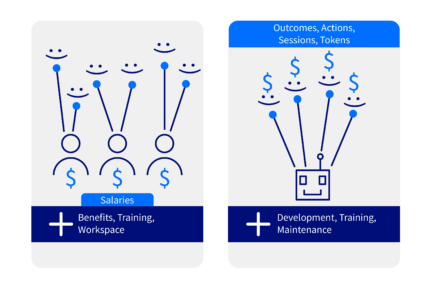

With consumption-based pricing comes a trade-off
Under this new and evolving model, variability transfers from the vendor’s side to the buyer’s side. Where per-seat pricing gave budgets a certain measure of predictability, largely insulating buyers from how the technology performed in production, consumption pricing aligns cost with actual usage. It exposes that usage directly to the buyer.
Consumption contracts read more like cloud compute agreements than software licenses. They carry caps, true-ups, overage rates, and reserved-capacity tiers. As a result, buyers need to model these against actual usage rather than seat counts. For example, Salesforce’s Flex Credits model is sold in three buying structures including pay-as-you-go and pre-commit. Cisco’s Webex Contact Center subscriptions automatically include overage SKUs that bill in arrears against committed values.
No wonder many procurement teams find themselves pricing and negotiating against an unfamiliar contractual surface.

The cost surface is wider than the invoice shows
In an agentic flow, a single resolved customer interaction can involve multiple model calls, retrieval steps, and tool calls into adjacent systems. Then there is handoff orchestration when more than one agent is involved. Each activity carries a cost, and most of those costs don’t appear as line items on the vendor’s invoice.
All of which becomes far more complex with multi-agent orchestration. Cisco has confirmed that Webex AI Agents will support multi-agent collaboration through agent-to-agent (A2A) and Model Context Protocol (MCP) standards in Q1 2026. The capability lets agents call other agents and external systems as part of a coordinated resolution. The implication: a customer interaction that resolves through five model calls and two tool invocations doesn’t cost what a list-price calculation implies. It costs more, and the variance compounds at scale.
IDC’s FutureScape 2026 forecast estimates G1000 organizations will face up to a 30% rise in underestimated AI infrastructure costs by 2027. IDC points to under-forecasting and missing AI-specific expense categories as the main drivers and calls the moment “the AI infrastructure reckoning.” Contact centers running agentic deployments at production volume have no choice but to adapt.

Governance is where the gap is widest
The exposure that IDC describes is governable, but only with disciplines most contact centers haven’t needed before. In the past, procurement bought seats, finance approved spend, and operations measured utilization against committed counts.
None of those workflows makes as much sense inside an agentic contact center, where the question should this AI agent have used a more expensive reasoning model? carries real financial implications.
Still, other parts of the enterprise have already built the discipline. The FinOps Foundation’s State of FinOps 2026 found that 98% of practitioners now manage AI spend, up from 63% the prior year, and AI cost management ranks as the single capability FinOps teams most plan to add. Cloud and engineering organizations have accepted that consumption-based spend requires consumption-based governance.
The contact center, historically managed under predictable per-seat agreements, may be falling behind.

The mindset shift CX leaders need
In agentic environments, observable cost matters more than fixed cost. A deployment whose cost behavior can’t be measured at the action level can’t be governed at the action level. The job of CX leadership is to make sure the organization can see what AI is costing while those costs are being incurred.
The instinct will be to negotiate back to predictability through capped consumption and fixed pricing demands. In some cases that’s the right short-term move, but it solves the wrong problem over time. The economics of agentic deployment are variable by design. Suppressing that variability through contracting tends to limit the value of the deployment or push the cost into less visible categories.
The more useful work happens earlier, at the architecture and operating-model level:
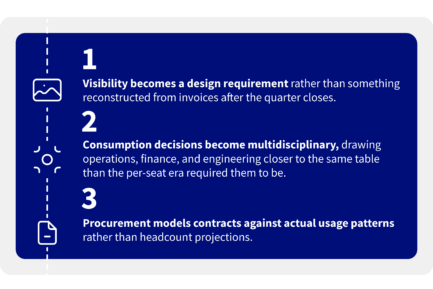
The contact centers that hold a compounding advantage in the agentic era will be the ones that build visibility and governance into the architecture early, while the technology and the contracting models around it are still maturing. The shift from access to activity is going to keep moving, and the organizations that meet it deliberately will be in a different position than the ones that meet it at renewal.

How Bucher + Suter is helping clients adapt
Bucher + Suter’s AI strategy work helps CX and IT leaders make those design and governance decisions before vendor contracts and architectural choices lock them in. We start by identifying the use cases where agentic AI will produce the most measurable impact in your environment, then develop the in-depth analysis that surfaces where the greatest value is. From there, we build the governance and measurement frameworks that align AI spend with the business outcomes you’re already accountable for. The aim is to make value predictable in a model that, by design, makes cost variable.